A dartboard looks confusing but follows simple rules. It is divided into 20 areas like slices of a cake, the segments. The number on the edge tells you how many points the segment is worth.
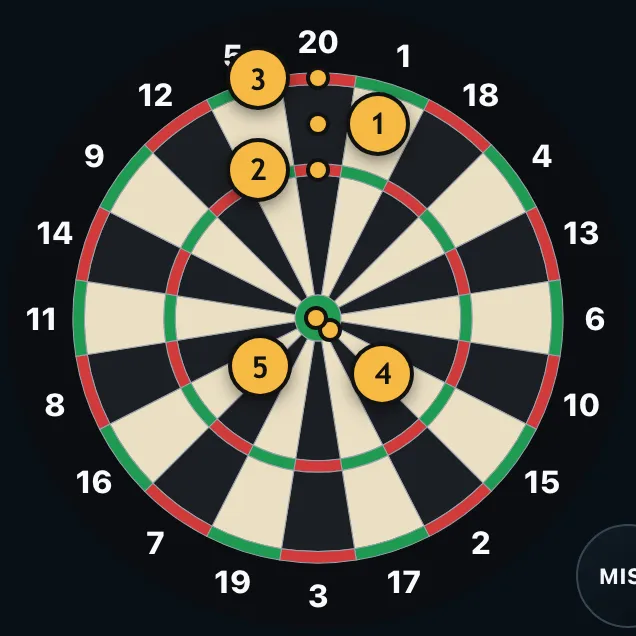
- Single: the large areas. They score the number on the edge, here 20 points.
- Treble: the narrow inner ring. Scores three times, treble 20 is worth 60 points.
- Double: the narrow outer ring. Scores twice, double 20 is worth 40 points.
- Bull: the green ring around the centre, 25 points.
- Bullseye: the red dot in the centre, 50 points. It counts as a double.
What scores how much?
| Segment | Short form | Points |
|---|---|---|
| Single 20 | 20 or S20 | 20 |
| Double 20 | D20 | 40 |
| Treble 20 | T20 | 60 |
| Bull (single bull) | 25 | 25 |
| Bullseye | Bull, BE or D25 | 50 |
| Miss | Miss | 0 |
Three darts in treble 20 make 180 points, the most a visit can score. If a dart lands outside the double ring, bounces out or falls out, it scores 0. In the app you tap "Miss" for it.
Why does everyone aim at the 20?
The 20 is the highest number and its treble is worth 60 points. But the 1 and the 5 sit right next to the 20. A narrow miss costs a lot of points there. That's why some beginners prefer to aim at the 19: its neighbours, the 7 and the 3, are similarly small, but treble 19 is worth 57 points, almost as much.
The numbers on the board are not in order of size. Big and small numbers alternate so that misses are punished. In time you'll know the order by heart: 20 at the top, then to the right 1, 18, 4, 13, 6 …
Hanging the board and the distance
In steel-tip darts, the centre of the bullseye hangs 1.73 m above the floor. The throwing line, the oche, is 2.37 m from the face of the board, measured along the floor.
And in the app?
You can enter the segments on the number keypad or tap them directly on a drawn board. How both work is explained under Entering darts and Board and voice.